Skip to content

Changelog

What's new in Flat. New features, improvements and fixes, newest first.

We release more than we list here. This page keeps the changes worth knowing about.

Building on the API or the Embed SDK? See the developer changelog

In September

37 smaller changes
Only this area
  • 28 SeptImproved

    Our scanning model has been updated, with a focus on time signatures, clefs and multi-bar rests. - More time signatures are read as printed. The model now…

    Read more
  • 30 SeptFixed
    Photos on grey or tinted paper now import, and a neighbouring page in the frame is ignored
  • 29 SeptFixed
    Instrument names are matched more reliably, including choir voices and abbreviated labels

    Labels like "Sop.", "Hn." or "Violin II" now resolve to the right instrument, and the instruments you confirm before import are always applied.

  • 24 SeptFixed
    Full scores, band charts and piano music keep all their systems and bars

    Large scores are no longer split or merged into the wrong systems, and multi-bar rests keep their bar count.

  • 24 SeptImproved
    Imported scores keep the staff size of the original page

    A page engraved with smaller or larger staves no longer comes out at one fixed default size.

  • 23 SeptFixed
    Lyrics, titles and credits are read more reliably, including Japanese and Korean text

    Syllables land on the right notes, and footers, dynamics or verse numbers are no longer sung. Titles and composers come from the right text, with credits in more languages.

  • 23 SeptFixed
    Japanese lyrics in PDFs with a text layer are no longer garbled

    Some PDFs store their Japanese text in an encoding that used to come out as unreadable characters. Lyrics and titles from these files are now read correctly, and an import set to several languages now uses all of them.

  • 22 SeptFixed
    Ties and multi-bar rests come through when you open an exported score in Dorico, Sibelius or MuseScore

    Tied notes now reach their second note in other notation apps, and a 22-bar rest is exported as 22 bars instead of one, so bar numbers match the original.

  • 18 SeptFixed
    Chord symbols, rehearsal marks, tempo marks and clefs are kept in more layouts

    Fewer markings are dropped or misread, from chords in Sibelius fonts to "rit." no longer setting a tempo.

  • 17 SeptFixed
    Photos of sheet music taken from a screen now import instead of failing with "no music detected"

    Photographing a monitor or tablet adds a fine pixel grid over the page that used to hide the staves. Imports now see through it.

  • 10 SeptFixed
    Cleaner MusicXML exports

    Clefs and figured bass appear only on the staves that carry them, pickup bars are numbered as in print, multi-bar rests and trill lines export as valid MusicXML, and cross-staff piano voices stay on the correct staff.

  • 9 SeptFixed
    Repeat, double and final barlines export in the right place in MusicXML with system breaks
  • 8 SeptFixed
    Metronome marks are read in more layouts, and "rit." no longer sets a tempo

    A mark clipped at the top of the page, written inside a sentence, or glued to a rehearsal letter is now read. Relative directions such as rit. or accel. no longer invent a tempo.

  • 8 SeptFixed
    Long tuplets no longer make an import fail
  • 2 SeptFixed
    Photos taken on an iPhone no longer import as two pages
  • 2 SeptNew
    Import scanned music from HEIC, TIFF, WebP, AVIF and GIF files, and from a single photograph
21 August·New·

Loop mode, and playback that picks up where you stopped

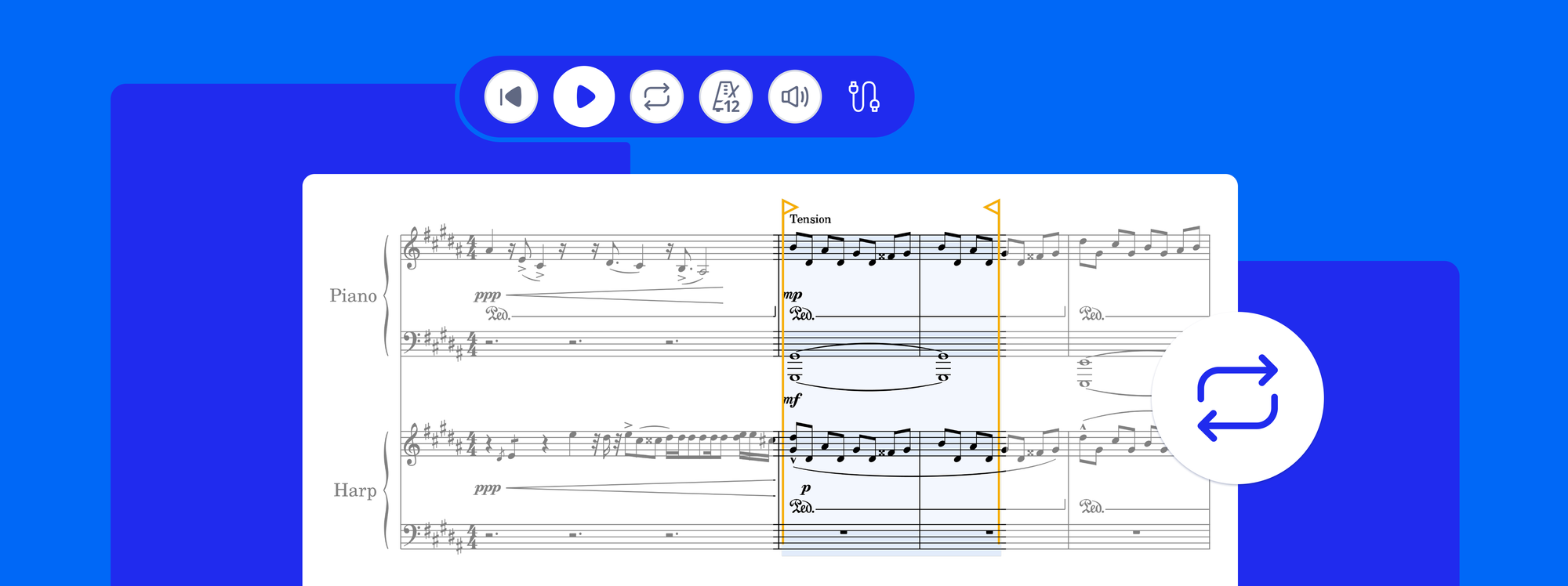
A selected passage in the Flat editor looping, with the loop handles around the bars and the loop button active in the header

Select a passage, press L, and it repeats until you tell it to stop, while the notes stay editable, so every change lands on the next pass. Loop mode is free on every plan.

  • Three ways to start a loop: select bars and press L, choose Loop from the selection menu, or press the loop button in the header to loop the bar your cursor is in. Drag the handles to widen or tighten the range, even while it plays.
  • The notes stay editable. Click a note as it plays, change it, and hear the result the next time round. Loops also work over a synced YouTube, Vimeo, SoundCloud or uploaded recording.
  • Playback starts from your cursor, not from the top. Stopping keeps the position: Space plays from the cursor, Shift + Space resumes exactly where the music stopped (press and hold Play on mobile). Going back to the start moves the cursor while stopped, and restarts playback while playing.

Available in the new editor on the web and on the new mobile toolbar on iOS and Android. Embedded scores can loop too, through the embed API.

4 August·New·

Import a PDF or photos in the desktop app

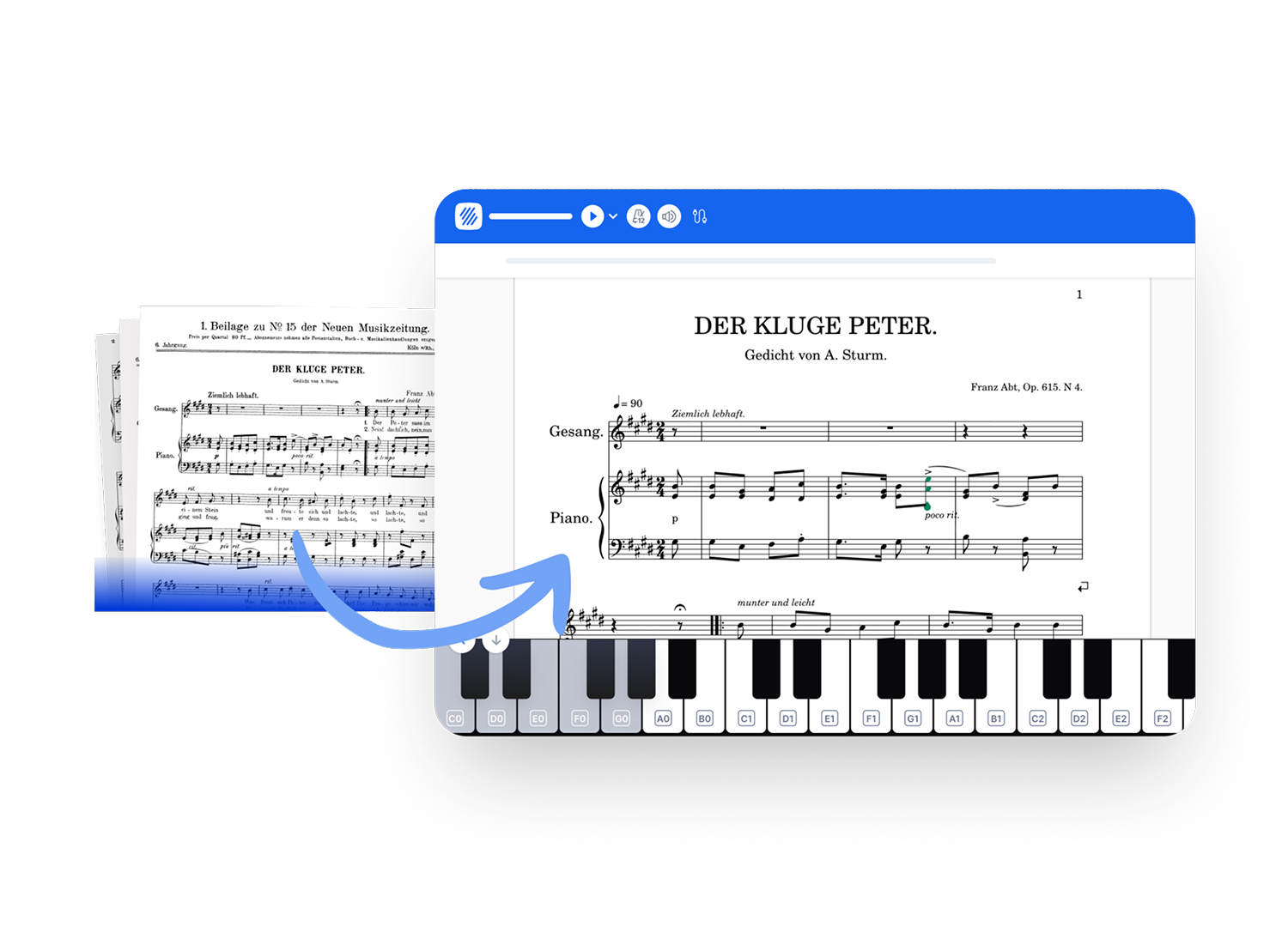
A printed score becoming an editable score in Flat

The Mac and Windows apps can now turn a PDF or a photo of sheet music into an editable score, with the same review step as the web.

  • Import without leaving the app. Pick a file, check what the scan read, and open the score.
  • Buy AI credits inside the app on the Mac App Store, so an import does not stop for a trip to the website.

Also in August

29 smaller changes
Only this area
  • 7 AugImproved

    A new version of our in-house model now powers every PDF and photo import, with a focus on how tuplets are printed on the page. - Implicit tuplets are now…

    Read more
  • 31 AugFixed
    Short text fragments no longer turn into instrument names
  • 31 AugFixed
    Directions such as "p legato" are no longer sung as lyrics
  • 31 AugFixed
    A pickup bar in a single-part score keeps its notes
  • 31 AugFixed
    A cover or licence page before the music no longer supplies the title
  • 31 AugFixed
    Tempo marks are no longer mistaken for a title, a lyricist or a bar number

    Metronome equations and tempo words such as "poco allegro" stay where they belong.

  • 31 AugFixed
    Composer and lyricist credits are read in more layouts

    Credits in Polish and Spanish, wrapped over two lines, split across text boxes, or set in the music font are now recognised.

  • 31 AugFixed
    Chord symbols are read more precisely, including diminished chords, sevenths and bare roots
  • 31 AugImproved
    Rehearsal marks are recognised in photos, not only in clean scans
  • 31 AugImproved
    More chord-symbol fonts are recognised in PDFs
  • 7 AugFixed
    Smaller fixes to lyrics, chord symbols, instrument names, tablature, pickup bars, and score details
  • 7 AugFixed
    Rehearsal marks attach to the bar they open rather than to the nearest note
  • 7 AugImproved
    Korean scores: Hangul titles and Korean performance directions are now recognised
  • 6 AugImproved
    An import left on the review step now finishes on its own after 24 hours

    If you close the review screen or lose the tab, the import no longer waits forever: after a day it continues with the title and instruments it detected, and the score lands in your library.

  • 6 AugFixed
    Scores whose stave layout changes mid-piece no longer lose staves or whole systems
  • 5 AugImproved
    Instrument names are identified more reliably, including Japanese names, transposition keys and numbered parts
  • 5 AugFixed
    PDFs containing both a lead sheet and a piano arrangement are split into the correct parts
15 July·New·

Import a PDF or photos into an editable score, with a review step

Importing sheet music from a PDF or a photo has a new flow on the web app, built on Flat's in-house recognition engine. It replaces the previous PDF import for everyone.

  • Pick the pages you want. Upload a PDF or several photos, then keep only the pages that contain the music. Each page you keep uses one credit.
  • Follow the recognition as it runs. A progress bar shows where the scan is, page by page, and you can keep using Flat while it works.
  • Review before the score is built. When the engine is unsure about an instrument, it asks you to confirm the title and the instruments it detected, with the part names printed on the page shown next to each one. When every instrument is certain, this step is skipped.

Available in Flat and, for teachers and administrators, in Flat for Education. The new flow comes to the iOS app in the coming weeks.

1 July·New·

Undo, redo and other editing gestures on touch screens

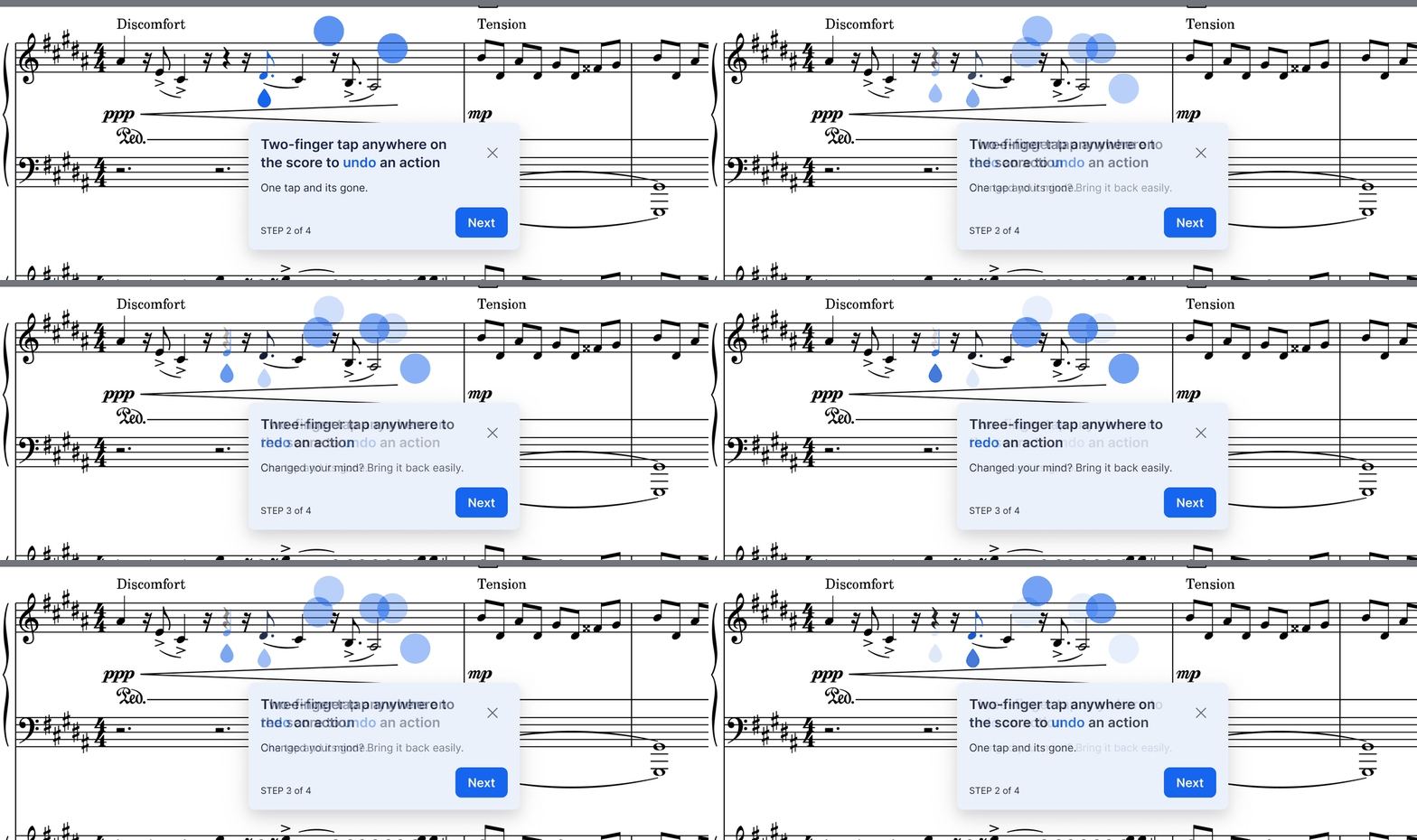
A two-finger tap on the score to undo, then a three-finger tap to redo

Your fingers can do more on the score. These gestures are on for everyone editing on a phone or tablet.

  • Undo with two fingers, redo with three. Tap anywhere on the score with two fingers to undo your last change, three to redo it, without reaching for a button.
  • Fit the page with a two finger swipe down. In page mode, the score resizes so a full page width fills the screen.
  • Double tap an instrument name to zoom to it, so you can work on one part without losing your place in the score.
  • Drag a note to move it. Drag sideways to put it on another beat, or up and down to change its pitch, with a magnifier above your finger so you can see the note you are aiming at.

Also in July

33 smaller changes
Only this area
  • 29 JulyImproved

    A new version of our in-house model now powers every PDF and photo import, with 22% to 51% fewer errors on our scanned sheet music benchmarks. The gains are…

    Read more
  • 24 JulyImproved

    An improved version of Flat's in-house model now powers every PDF and photo import, in particular: - Multi-voice passages with shared rests and invisible rests…

    Read more
  • 10 JulyNew

    Flat's OMR engine is now available programmatically through the developer API. Send PDFs or photos, follow recognition progress, review the detected…

    Read more
  • 31 JulyImproved
    Import a PDF or photos on Android with a review step before the score is built

    The import flow on Android has been rebuilt on the same engine as the web app: pick the pages you want, check the detected title and instruments, then let the scan finish while you keep using the app. Opuscan for Android gets the same wizard.

  • 29 JulyFixed
    Piano right hand no longer ends up on the bass staff

    In some piano scores, the second voice inherited the staff of the previous one, so right-hand notes were written on the bass staff.

  • 23 JulyFixed
    Fewer dropped notes on dense systems, and no more rhythm slashes after a triplet passage

    Busy systems that continue from the previous line no longer lose notes, a part that mixes triplet and plain systems no longer turns into rhythm slashes halfway through, and slurs and articulations placed on a double stop stay on the chord.

  • 21 JulyImproved
    Clef changes in the middle of a bar are now recognised
  • 20 JulyImproved
    Lyrics and text are recognised in more languages, including Vietnamese, Thai, Arabic and Hindi

    Text recognition now covers Vietnamese, Thai, Arabic, Persian, Urdu, Hindi, Marathi, Nepali, Bengali, Tamil, Telugu and Kannada, plus 24 more Latin-script languages such as Czech, Hungarian, Croatian and Lithuanian. Words with accents and diacritics are also kept instead of being discarded as unreadable, and Hebrew text embedded in a PDF is no longer thrown away.

  • 12 JulyImproved
    Instrument names are matched more reliably, including band section labels and Chinese scores

    A bare "Horn" now resolves to the French horn instead of the cor anglais, "Alto" and "Tenor" on a band part to saxophones, brass band basses to the tuba, and a percussion clef misread on a pitched part is corrected. A vocal line that enters after a piano introduction is recognised as a voice instead of a second piano. On Chinese scores, the 詞 and 曲 labels route the names to lyricist and composer, and bilingual lyrics keep every verse. Changing the instrument of a drum part in the review step keeps the drum kit.

  • 10 JulyFixed
    Fixed some multi-voice passages where the two voices share a rest
  • 10 JulyImproved
    Courtesy (cautionary) accidentals are now recognised
  • 10 JulyNew
    A photographed two-page book spread is split into two pages

    Photograph an open book and the import reads the left and right pages one after the other, instead of as one wide page.

16 June·New·

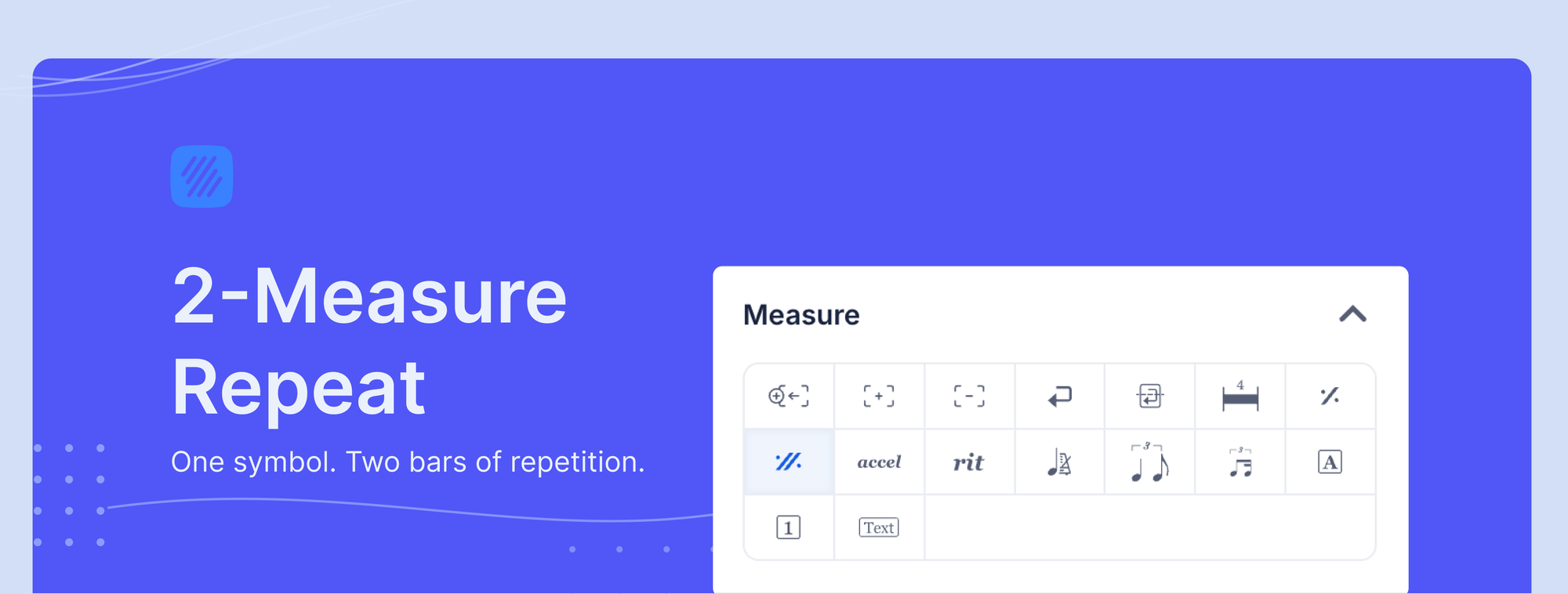
Two bar repeats

A rhythm part with a two bar repeat symbol spanning two bars

Rhythm parts often repeat two bars at a time rather than one. You can now write that with a proper two bar repeat symbol, instead of copying the bars out by hand.

  • Add it from the notation tools and the symbol spans the two bars it stands for, drawn the way a player expects to read it.
  • Playback follows the repeat, so what you hear matches what is on the page.

It sits alongside the single bar repeat that was already there, and works the same way.

16 June·New·

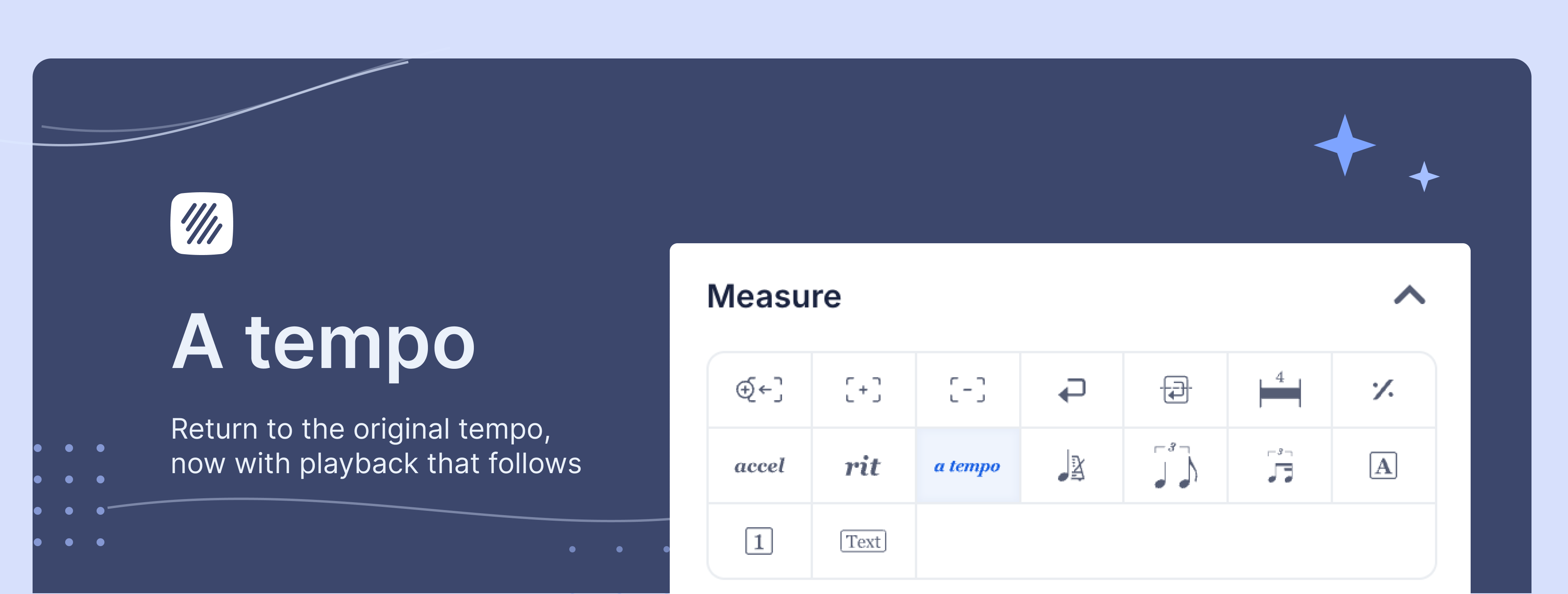
A tempo

A staff with a ritardando followed by an a tempo marking above it

After a ritardando or an accelerando, a score needs a way to say "back to the previous tempo". A tempo is now a marking you can add.

  • Insert it from the notation tools and it is drawn above the staff, where a player expects to find it.
  • Playback goes back to the tempo in force before the change, so a rit. followed by a tempo sounds the way it reads.
  • It survives MusicXML, both ways, so the marking is still there when a score moves between Flat and other notation software.
16 June·New·

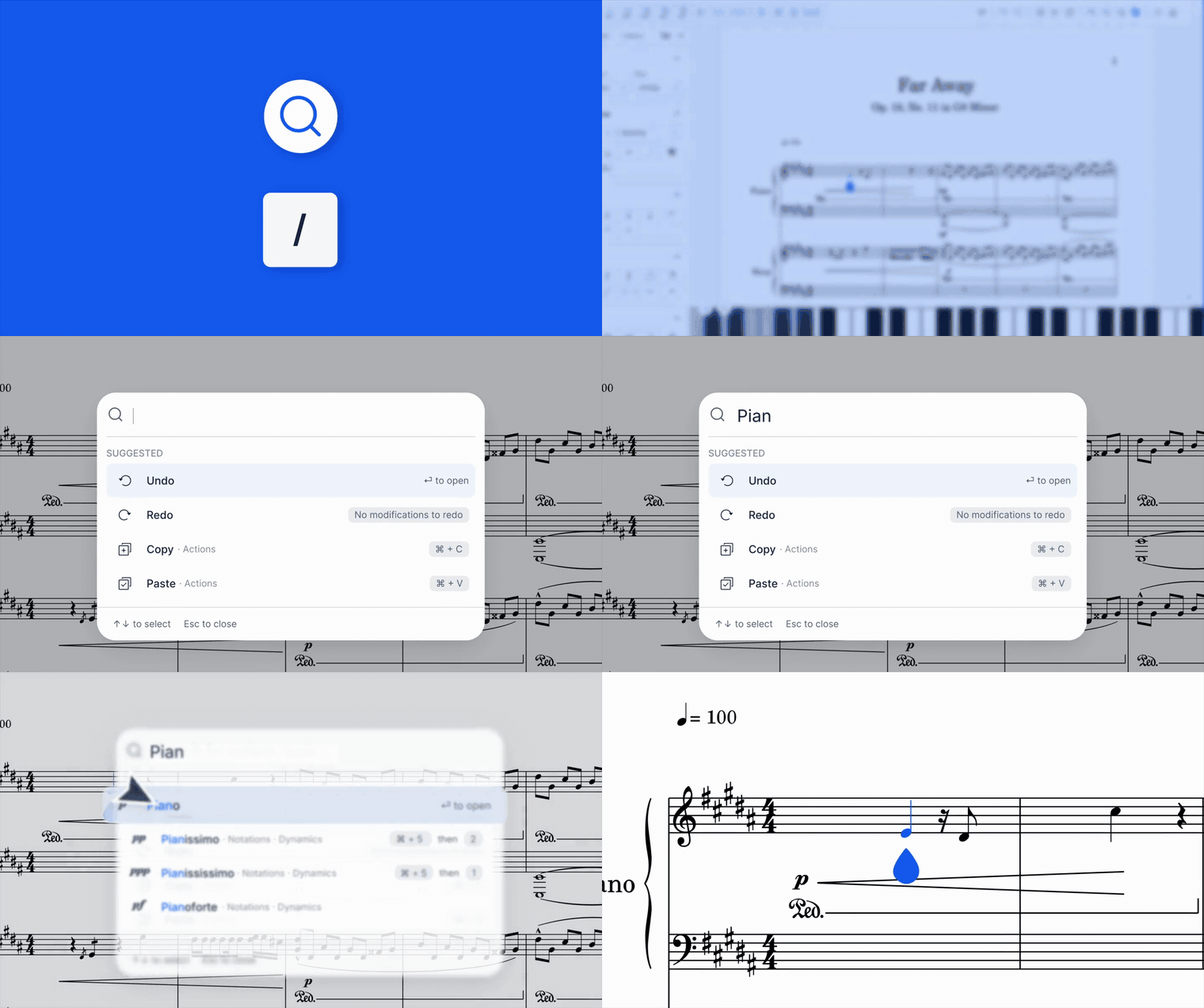
Find any tool by typing what you want

Quick search open over a score, with results for a typed query

Quick search puts every editor tool one keystroke away. Open it, type what you want, and press Enter: no hunting through the toolbar for the panel it lives in.

  • Search by what you call it. Type "triplet", "repeat bar", "crescendo" or the name in your own language, and the right tool comes up. It understands a wide range of names for the same thing, in 21 languages.
  • Your recent actions come first, per score, so the tools you are using on this piece stay at the top of the list.
  • Tools you cannot use right now are shown as unavailable, with the reason, instead of quietly doing nothing.
  • It works from the keyboard end to end, with full screen reader support.

Available in the new editor toolbar.

Also in June

22 smaller changes
Only this area
  • 23 JuneImproved

    We've improved how scanning reads the layout of a page. Imports of PDFs and photos now produce cleaner, more accurate scores, especially on complex layouts: -…

    Read more
  • 15 JuneImproved

    Every PDF and photo import is now processed by Flat's own in-house model. This release is a major new version focused on transcription accuracy: musical…

    Read more
  • 1 JuneNew

    We're rolling out Flat's own AI model for PDF and photo import, designed and trained in-house to replace the third-party engine used at launch. Owning the…

    Read more
  • 24 JuneImproved
    Chord symbols: fixed-Do names (REm, SIb, LA7), stacked extensions and accidentals are kept

    Chord symbols written with solfège names are recognised, extensions stacked over the chord ("sus4" under "A7(6)") are folded back onto it, and sharps and flats drawn in the notation font of a digital PDF are read instead of dropped. Chord symbols detected by text recognition are imported as chord notation rather than discarded.

  • 24 JuneFixed
    Page numbers, catalogue numbers and attribution lines no longer become titles, credits or bar numbers

    Page and catalogue numbers no longer shift the bar numbering, "Words and Music by" and bare "by" lines no longer end up in the composer or subtitle, flush-left movement headings go to the movement title, boxed rehearsal numbers are kept, and expression text above or below the staff is imported as a direction rather than as a credit.

  • 24 JuneImproved
    Instrument names resolve to the right part more often, in more languages, and transposing parts sound at concert pitch

    Part names printed in the margin or in the header now match the right instrument more often for organ, choir, percussion and band scores, including abbreviations, plurals and ordinals ("1st & 2nd Horns in F"), and names in Japanese and other languages are looked up too. Dynamics, metronome marks and lyric syllables next to the staff are no longer mistaken for a part name. Transposing instruments are exported with their transposition so they play back at concert pitch.

  • 23 JuneImproved
    Jazz scores, when correctly detected, now apply a jazz chord style and handwritten jazz music font automatically
  • 23 JuneImproved
    Beams that span rests (for example, note / rest / note) are now supported
  • 23 JuneImproved
    Custom beaming patterns are now recognised and preserved on import
  • 15 JuneFixed
    Pickup bars, multi-bar rests and overfull bars import cleanly

    A pickup bar is carried to every part instead of being created from a lone short bar, printed multi-bar rest counts are read as such, bars that overflow by one duration are corrected from the model's next best guess, and notes with a missing duration inherit the current one instead of disappearing. Unpaired ties and tremolos or noteheads the editor could not load no longer make the whole import fail.

22 May·New·

Flat for Mac and Windows

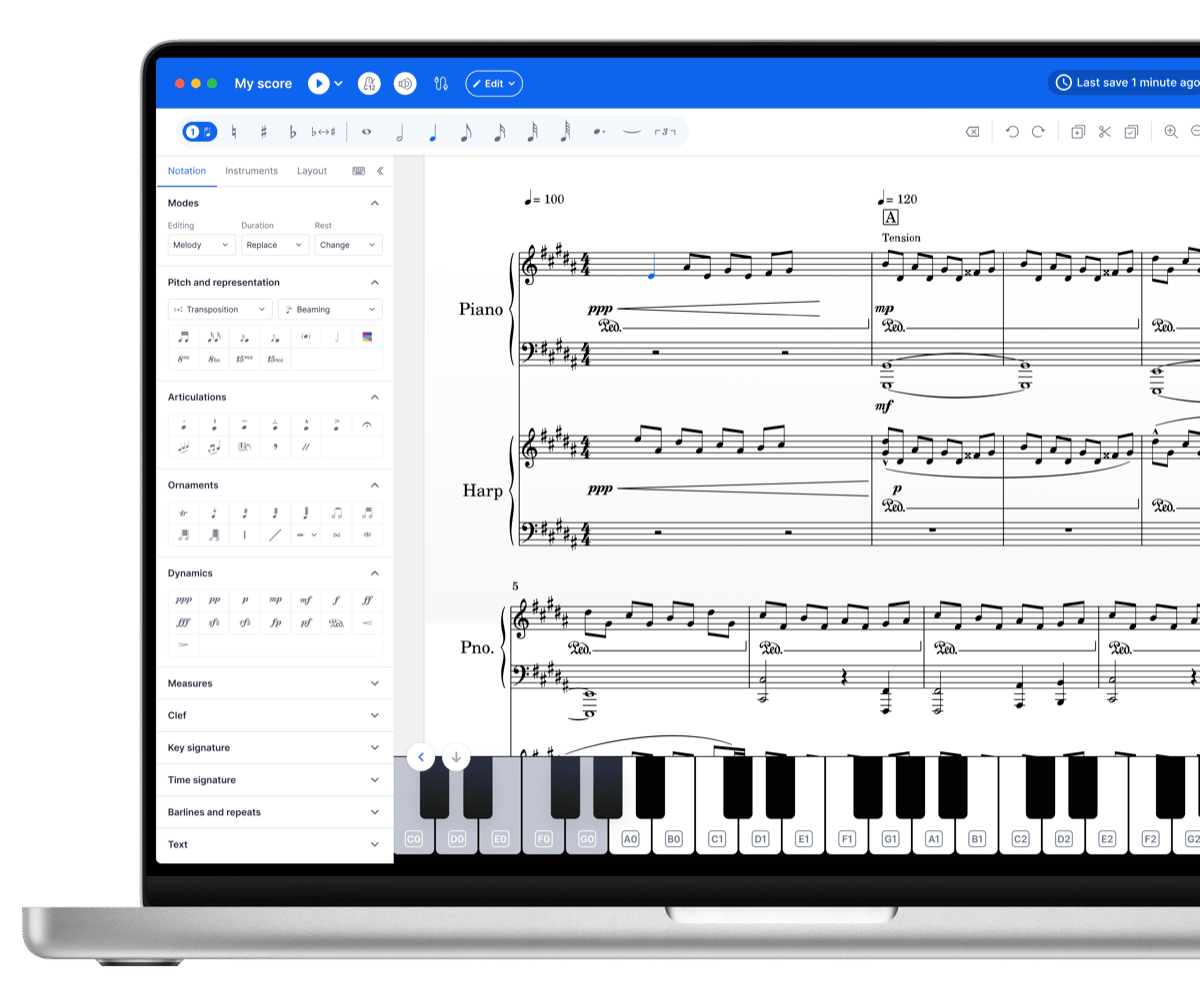
The Flat desktop app open on a piano and harp score on a MacBook, with the notation panel on the left and the piano keyboard below

Flat now has a desktop app for macOS and Windows: the full editor in a window of its own, free to download, with your library in sync across desktop, web and mobile.

  • Works offline. Write, edit and play back scores without a connection; your changes sync when you are back online.
  • Your scores on every device. With Flat Power, the library you see on the desktop is the same one you open on the web, iPhone, iPad and Android.
  • MIDI input over USB and Bluetooth. Plug in a keyboard and play the notes in.
  • Opens your files. Double-click a score in Finder or Explorer and it opens in the app, not a browser tab.
  • Sign in with Apple on macOS, alongside the sign-in options you already had.
  • Keeps itself up to date. New versions install on their own.

Free to download; a Flat account is only needed to sync. Get it at flat.io/desktop.

Also in May

2 smaller changes
24 April·New·

Swing semiquavers

A score with a semiquaver swing marking above the staff

Swing is not only for quavers. You can now swing semiquavers, for shuffle and funk feels that the quaver setting could not express.

  • Pick the unit when you turn swing on, for the whole score or from any point in it: quavers as before, or semiquavers.
  • Playback interprets the unit you chose, so what you hear matches the marking on the page.
  • The marking is written on the score, so anyone reading the part knows how it should be played.

Also in April

2 smaller changes
26 March·New·

A new editor toolbar on the web

The new editor toolbar, moving through the Notation, Instruments and Layout panels

The editor toolbar has been rebuilt, so tools are grouped where you expect them and the score gets more room. It is open to everyone as a beta: turn it on from the banner in the editor.

  • Notation tools are grouped into categories, each with its own keyboard shortcut, shown in the panel as you open it.
  • A layout panel for the whole score. Page and staff size, note spacing, bars per line, bar numbering, and your notation and text styles, all in one place, with non-playing instruments hidden in a click.
  • An instruments panel in the sidebar. Rename and configure an instrument without leaving what you are working on, and reorder the score by dragging.
  • Workflow modes. Point the number keys at articulations, ornaments or dynamics, and make a whole pass over the score without leaving the keyboard.

Looking for something older?

Older updates are written up on the Flat blog, release by release.